Aligners · 10 min read
Clear Aligners for Adults: Are You a Candidate?
Learn who qualifies for clear aligners, which cases need a different approach, and why a digital case assessment beats any online quiz.
Mineers Smile Center
You have probably seen the advertisements, scrolled past the before-and-after photos, and maybe even taken one of those online quizzes promising to tell you whether Invisalign is right for you. The question running through most adults' minds before their first orthodontic consultation is a simple one: will aligners actually work for my teeth?
The honest answer is that it depends, and the only way to know for certain is a proper clinical assessment. Research consistently shows that adults with mild-to-moderate crowding, spacing, or minor bite issues are strong candidates for clear aligner therapy. However, roughly 20 to 30 percent of cases involve complexities that call for a different approach, and no online quiz can reliably tell you which group you fall into.
This post explains what clinicians evaluate when assessing aligner candidacy, the cases where another treatment is the smarter path, and why a digital case assessment gives you a clear, visual answer before you commit to anything.
What Clear Aligners Can and Cannot Do
Clear aligners work by applying controlled, gradual forces to move teeth along a pre-planned digital path. Each tray in a series moves teeth a fraction of a millimetre, building toward a final position mapped out before treatment starts. That mechanism makes aligners genuinely effective for mild-to-moderate crowding and spacing, which covers the majority of cases adults bring to a first consultation.
The evidence supports this scope. Research from the University of Campania Luigi Vanvitelli found that crowding correction with aligners produces predictable outcomes in mild-to-moderate, straightforward cases. Predictability matters here: it means consistent, reliable results across a broad population of adult patients, not just occasional successes.
The limits are equally real, and worth understanding before any money is spent. Aligners have measurable limitations in cases with significant jaw discrepancies, severe rotations of the back teeth, or large vertical bite problems, movements that usually need additional appliances or a different treatment. These are mechanical limits, not brand or technology differences.
The most common misunderstanding adults carry into a consultation is that aligners solve everything. That assumption leads to disappointment when a clinician identifies a case that needs a different route. Knowing the real scope in advance turns that conversation from a setback into useful clinical information.
Fixaligner®, the aligner system used at Mineers Smile Center, works within this same evidence-based framework. When the case fits the criteria, it produces reliable, visible results. When it does not, knowing that early is what protects both the outcome and the investment.
The Candidacy Criteria: What Clinicians Actually Check
Knowing what aligners can do is one thing; knowing whether your teeth fit within it is another. Clinicians look at six factors before recommending any treatment.
Crowding severity. Expert consensus supports predictable outcomes in mild-to-moderate, straightforward crowding, as reflected in published research. Beyond that, tooth movement becomes less predictable and additional mechanics are often required.
Spacing and gaps. Aligners close spaces effectively in most adult cases, including a gap between the front teeth and minor spacing spread across several teeth. This is one of the more consistent strengths of aligner therapy.
Bite classification. A Class I bite, or a mild Class II with no significant skeletal involvement, is generally aligner-friendly. A pronounced skeletal Class III, a deep bite where the upper teeth touch the lower gum, or an anterior open bite usually needs hybrid or fixed treatment instead.
Gum and bone health. Active gum disease, significant bone loss, or untreated decay must be fully resolved before any orthodontic movement begins. This is a candidacy gate: moving teeth on a compromised foundation speeds up further bone loss. It is worth raising gum health with your dentist early.
Tooth anatomy and previous work. Heavily restored teeth, missing teeth, and existing implants all affect how aligners grip and move the teeth. These cases need individual evaluation, not a blanket yes or no.
Wear. Aligners must be worn consistently through the day and night. Your dentist will discuss the wear requirements and your routine during the assessment, because consistent wear is part of candidacy, not just aftercare advice.
The 20 to 30 Percent Who Need a Different Approach
Even when most criteria line up well, roughly 20 to 30 percent of orthodontic cases presenting to a clinic fall outside straightforward aligner treatment. Peer-reviewed data supports this estimate, with skeletal discrepancies, severe crowding, significant bite issues, or gum problems placing these patients in a different clinical category.
That is not a closed door. It means the path to a good result runs through a different approach: hybrid treatment combining aligners with attachments or elastics, full fixed braces, or, in true skeletal cases, surgery combined with orthodontics. The destination is the same; the route is more specific.
Common presentations in this group include:
- Severe crowding that needs extractions to create space
- Skeletal open bites, where the front teeth do not overlap vertically
- Significant deep bites, where the upper teeth cover the lower teeth too much
- Pronounced jaw asymmetries with a skeletal origin
Patients with active gum disease or significant bone loss must resolve those issues first.
Being told aligners are not the right fit is not a rejection. It is a precise diagnosis, and a precise diagnosis is the only foundation for a stable, lasting result.
Why Online Quizzes Cannot Answer This Question
Many adults turn to online self-screening tools first, and that's where the process breaks down.
These quizzes ask you to describe your own bite, crowding, and spacing. That takes clinical knowledge most people don't have. Most adults cannot reliably tell a skeletal jaw discrepancy from a dental one by looking in a mirror, yet that distinction decides whether aligners will work for their case.
Skeletal discrepancies are invisible without diagnostic imaging. A jaw relationship problem can look like ordinary crowding to an untrained eye. Identifying it accurately takes 3D scanning and bite analysis, not a multiple-choice question about whether your teeth feel "slightly" or "very" crowded.
Real candidacy gates include bone levels around the teeth, individual tooth angles, existing crowns or bridges, and gum health. The American Association of Orthodontists has led formal efforts to standardise exactly these criteria. No online quiz touches any of them.
There is also an incentive problem. Tools hosted on aligner brand websites exist to start a conversation, not to do the clinical gatekeeping that protects your outcome.
The real cost of that gap is paid mid-treatment: longer timelines, added fees, and results that fall short because the wrong tool was used from the start. The only reliable first step is a proper clinical assessment.
What a Proper Digital Case Assessment Involves
So what does a real assessment look like, compared with a quiz that takes 90 seconds?
It begins with detailed facial and intraoral photographs. These capture the teeth, gum levels, bite, and smile line in a way a quick look cannot. They also show how your smile works in the context of your whole face, not just how your teeth look in isolation.
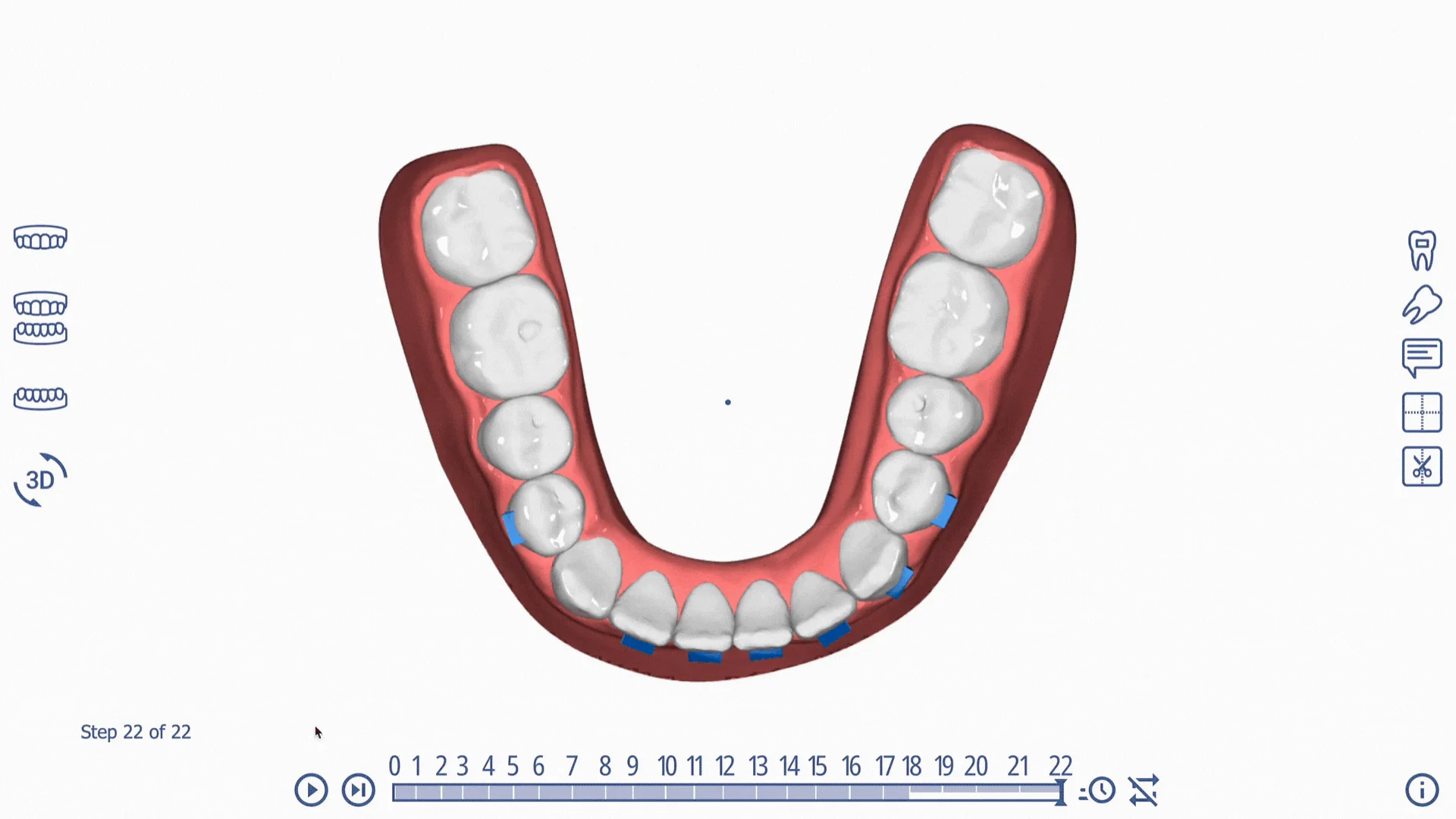
The clinical core of the assessment is a 3D intraoral scan. A small handheld scanner builds a precise digital model of both arches and the way your teeth meet. This is what makes precise measurement possible: crowding, tooth angles, space distribution, and bite depth can be measured rather than estimated. A 2023 systematic review of intraoral scanning in orthodontics confirmed the technology is accurate enough for treatment planning and aligner fabrication.
At Mineers Smile Center, this scan drives every Fixaligner® case evaluation. The result is a digital treatment simulation you can review on screen before any commitment is made. You can ask questions, request adjustments to the proposed outcome, and understand the full timeline. That is a very different experience from receiving a treatment plan and being asked to sign it.
The assessment also includes a clinical review that can flag findings needing attention before tooth movement begins, such as gum health or existing restorations, so you have a complete picture of your oral health.
Testineers, our smile try-in, takes the simulation one step further: a 3D-printed mock-up lets you see and feel the planned result before a single aligner is made.
Invisalign and Other Aligner Systems: Understanding Your Options
Knowing what your assessment involves is one part of the decision. Knowing how aligner systems compare is the other.
Invisalign is the most widely recognised clear aligner brand, and it is the term most adults search first. That familiarity is a useful starting point, but it can create a misleading frame: the brand name becomes a stand-in for the whole category, when in reality several aligner systems work on the same clinical principles.
Before-and-after images deserve careful reading. The results shared online span a wide range of case types, from simple spacing to more complex bite correction. Not every outcome shown was achieved with aligners alone; many involved attachments, elastics, or preparatory work that never appears in the photo.
Pricing follows the same pattern. Aligner fees vary with geography, case complexity, and the clinic. At Mineers, the cost of Fixaligner® treatment is discussed with you at your consultation, once your teeth have been examined and your treatment is planned.
The more important distinction is this: the plastic is not the differentiator. What separates aligner outcomes is the digital planning behind the treatment, the rigour of case selection, and the clinical supervision throughout.
For patients comparing international options, including those planning treatment around a visit to Lebanon, the relevant question is not which brand name is on the aligner. It is whether the clinic's assessment is thorough enough to catch complexity before it becomes a problem mid-treatment.
If You Are Not a Candidate, What Comes Next
If your case falls outside straightforward aligner candidacy, here is what the evidence supports as the next step.
Hybrid treatment is the first alternative worth understanding. Combining aligners with attachments, elastics, or temporary anchorage devices extends what aligners can do, and it suits a meaningful share of the more complex cases. The aligner does part of the work; the extra components handle the movements aligners cannot make predictably on their own.
Fixed braces remain the most versatile orthodontic tool. For severe crowding, significant bite correction, or cases that need extractions, the evidence shows fixed appliances produce more complete results in these specific scenarios.
Surgery combined with orthodontics is the appropriate path when a true skeletal discrepancy is present. It is a bigger undertaking, but for the right case it is also the only route to a lasting result.
At Mineers, the digital case assessment shows which of these paths applies to you, with a clear comparison of options, expected timelines, and what the end result should look like, before any commitment is made.
Being told aligners are not right for your case can be disappointing, and a good dentist acknowledges that directly. The goal is your outcome, not your preference for a particular appliance.
The Only Reliable Answer Is a Real Assessment
Whichever path is right for you, the first step is the same: find out precisely where your case stands.
Most adults with mild-to-moderate crowding or spacing are good clear aligner candidates. "Most," however, is not "all," and that distinction has real consequences for your timeline and your budget. The only way from uncertainty to a concrete answer is a proper clinical assessment, not an online quiz.
That assessment, with a 3D scan, an on-screen simulation, and the Testineers try-in, gives you a concrete answer before any commitment. If Fixaligner® is right for your case, you see the projected result before a single aligner is made; if another path serves you better, you leave knowing that clearly too.
Book a private consultation or call +961 3 757 127 for a clear, evidence-based answer about your smile.
Conclusion
Clear aligners are a proven, effective treatment for a great many adults, but they are not right for every case. The key takeaways are straightforward: candidacy depends on clinical specifics, not personal preference; roughly one in four adults will do better with another treatment; and no online tool can replace a proper assessment.