Implants · 8 min read
Dental Implants vs Bridges: Which Tooth-Replacement Option Lasts Longer?
Bridge or implant? Compare lifespan, lifetime cost and the effect on your other teeth to find the right tooth replacement for you.
Mineers Smile Center

Losing a tooth is stressful enough without having to navigate a maze of treatment options and price tags. If you've been told you need a tooth replacement, chances are you're already weighing up the two most common solutions: dental implants and bridges. And like most people, your first question is probably about cost.
Here's the thing, though. The upfront price is actually the least important number in this decision.
The question that really matters is what you'll end up paying, and what you'll end up losing, over the next 10, 20, or 30 years. Those are two very different conversations.
In this post, we'll break down how bridges and implants work, what each one does to the teeth around the gap, and how the lifetime costs compare side by side. We'll also cover who makes a good candidate for implants, and how 3D-guided surgery takes the guesswork out of the process from day one.
The Real Question Isn't Price, It's What You Pay Over a Lifetime
Most patients comparing a bridge to an implant stop at the sticker price. The bridge looks cheaper, the conversation ends there, and a long-term decision gets made on short-term numbers. That's a costly way to choose.
The more useful question is: how many times will you pay for this tooth replacement over the next 20 or 30 years?
Bridges have a finite lifespan, and when a bridge fails, the entire structure needs replacing, meaning you pay for the full procedure again. Over a lifetime, that can mean two or three replacement cycles.
Dental implants work on a different timeline. A 20-year meta-analysis of implant survival rates shows implant posts keep performing well over decades, with one cohort study following 10,871 implants for up to 22 years. The post itself can last for decades. Only the crown on top may need replacing from time to time because of normal wear, a far smaller procedure than replacing a whole bridge.
That gap in replacement frequency is where the real cost comparison lives. For more on how the two options differ structurally, see Dental Implants vs Dental Bridges: Key Differences Explained.
How a Dental Bridge Works (And What It Costs Your Healthy Teeth)
What exactly does a bridge involve? Understanding the mechanics makes the trade-offs much easier to weigh.
A traditional fixed dental bridge spans a gap by anchoring to the two natural teeth on either side, called abutment teeth. Those neighbouring teeth act as the pillars supporting the artificial tooth in the middle.
Here is the part most patients do not hear clearly enough: to attach the bridge, both abutment teeth must be prepared and capped with crowns. This is not a minor adjustment. It is irreversible. Once that tooth structure is removed, it cannot be restored.
Those prepared teeth then depend on the bridge. If the bridge fails, cracks, or develops decay underneath, both abutment teeth are compromised along with it. You started with one problem tooth; a failing bridge can turn that into three.
There is also a longer-term issue beneath the gap. Because a bridge does not replace the tooth root, it does not stimulate the bone the way a natural tooth does, a factor worth discussing with your dentist.
On the cost side, insurance coverage for bridges varies by plan, so confirm with your provider.
Bridges are a legitimate option for patients who are not implant candidates. But for patients who do qualify for implants, the permanent sacrifice of two healthy teeth deserves careful thought.
How a Dental Implant Works (And Why the Root Matters as Much as the Crown)
A dental implant is built differently from the ground up, and that difference starts below the gumline.
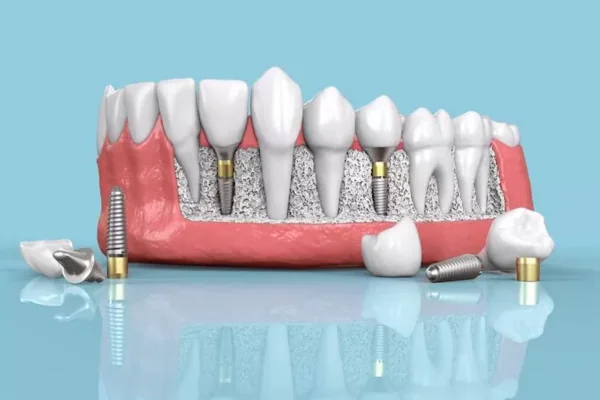
The basic structure: a small titanium post is placed into the jawbone, acting as an artificial root. Once healed, a ceramic crown is attached on top. The result looks, feels, and works like a natural tooth.
The post does something a bridge cannot. Through a process called osseointegration, the jawbone grows around the titanium and fuses with it. The implant becomes part of your bone, stimulating it the way a natural root does. That stimulation is what prevents the bone loss that quietly progresses under a bridge. We explain it in more depth in What Is Osseointegration in Dental Implants?
Equally important: no neighbouring teeth are involved. No grinding, no capping, no permanent change. The adjacent teeth stay exactly as they are.
Day to day, an implant crown asks nothing unusual of you. Brush it, floss around it, eat normally.
The one real trade-off is time. Osseointegration takes several months before the final crown can be placed, so an implant is slower upfront than a bridge. That healing period is not a complication; it is the biology working correctly.
On cost, a single implant is a higher upfront investment than a bridge, and insurance coverage varies by plan. But spread across 20 years, the yearly cost often compares favourably with paying for two or three bridge replacements over the same period.
Lifespan and Lifetime Cost, Side by Side
| Bridge | Implant | |
|---|---|---|
| Upfront cost | Lower | Higher |
| Year 10 | Often a full replacement | Possibly a new crown |
| Year 20 | Often a second full replacement | Usually nothing new |
| Adjacent teeth affected | Yes, re-treated at each replacement | None |
| Bone health | No root stimulation | Preserved |
Implants can remain stable across two decades, which often makes a crown replacement the only likely expense in that window.
The longer the years ahead of you, the more decisively implants win on total cost, an effect that usually becomes clear over a 20-year period.
Who Is (and Is Not) a Good Candidate for Dental Implants
The lifetime-cost argument only holds up if you're a candidate for an implant in the first place. Here's an honest breakdown.
Jawbone density is the foundational requirement. The titanium post needs healthy bone to fuse with. Patients who have lost significant bone may need a bone graft first, which adds time and cost but often still makes implants possible.
Gum health is equally non-negotiable. Active gum disease must be fully treated before an implant is placed. Placing an implant into infected tissue greatly increases the risk of failure. Gum health isn't just cosmetic; it's structural.
General health can also affect candidacy. Conditions such as diabetes may slow healing and can interfere with osseointegration. Your dentist will review your full health history as part of the assessment.
Age matters on both ends. Implants are not appropriate while the jawbone is still growing; your dentist will assess skeletal maturity. At the other end, the more years ahead of you, the more years you have to spread the upfront investment over.
None of this means implants are the answer for everyone. Patients who aren't candidates because of bone volume, health history, or personal preference can still do well with a bridge. The goal is an accurate assessment, not a blanket recommendation.
The only reliable way to know where you stand is a proper clinical workup with 3D imaging.
How 3D-Guided Surgery Makes Implant Treatment More Predictable
Once you know you're a good candidate, the next question most patients ask is: what is the procedure actually like? That uncertainty, more than cost, is often what makes people hesitate.
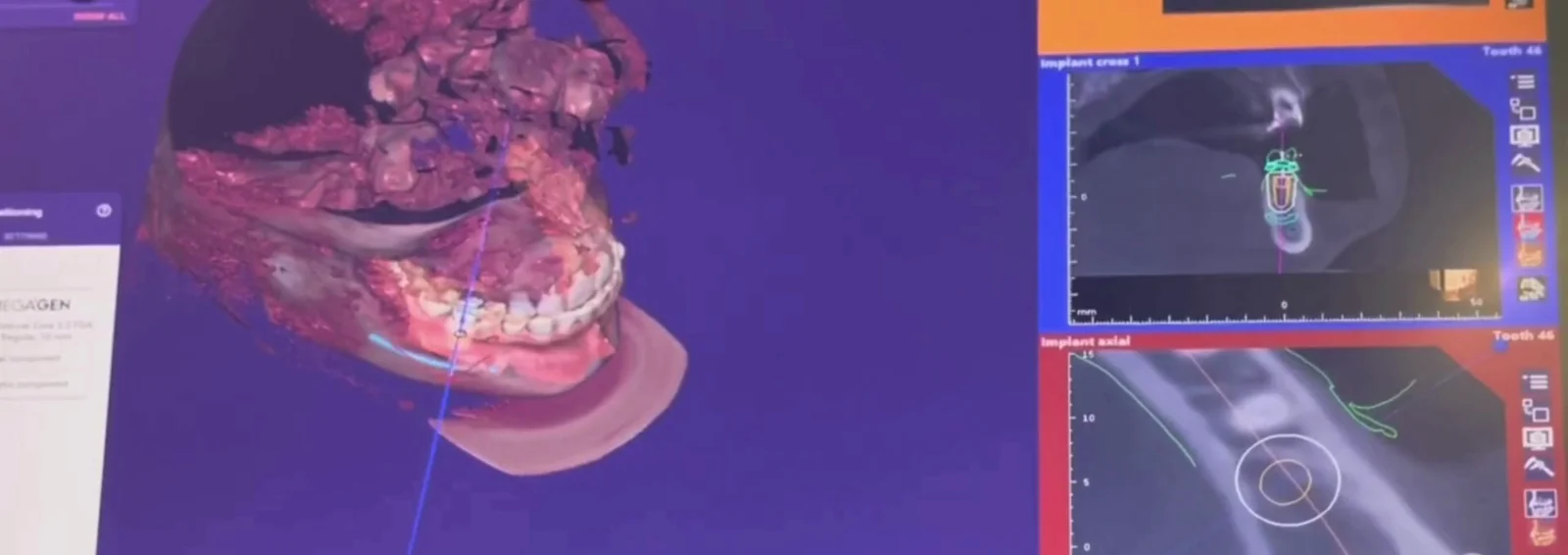
At Mineers Smile Center, implant treatment starts with a 3D scan of your teeth and a 3D X-ray of your jaw, completed before anything else. The implant's position, angle and depth are planned on screen in advance. Nothing is left to guesswork on the day of surgery.
From that plan, a surgical guide is made. During the procedure, it sits over your teeth and holds the drill exactly where the plan says it should go, removing the variables that make freehand surgery less predictable. Clinical research shows that fully guided placement reduces deviation at both the top and the tip of the implant compared with partially guided or freehand approaches.
Patients also see the planned outcome on screen before treatment begins. You can read how that works end to end in Digital Dentistry in Clinical Practice.
That shift, from uncertain to visible and planned, is what guided surgery actually delivers for patients.
Bridge vs Implant: A Quick Summary
| Factor | Bridge | Implant |
|---|---|---|
| Lifespan | Finite; full replacement when it fails | Post can last decades; the crown may need replacing |
| Adjacent teeth | Two healthy teeth prepared and capped | Neighbouring teeth untouched |
| Bone health | No root stimulation beneath the gap | Post stimulates bone like a natural root |
| Upfront cost | Lower | Higher; lower in total over many years |
| Best for | Patients who are not implant candidates, or who need a faster option | Patients with enough bone who want the lasting, tooth-preserving choice |
The pattern is consistent across every row. The bridge wins on short-term convenience; the implant wins on everything that adds up over time.
Which Option Is Right for You?
If you have enough bone and healthy gums, a 3D-guided implant is usually the better long-term choice, particularly when you have many years ahead of you.
A bridge remains the right answer for non-candidates, with full awareness of the replacement cycle and bone-health considerations covered above.
The worst outcome is choosing a bridge simply because no one walked you through the full picture. That is the gap this article was written to close.
What this article cannot do is tell you which option fits your bone, health history, and budget. That takes a proper clinical assessment, not an online comparison. A consultation at Mineers includes 3D scans and a digital plan you can see on screen before anything is decided, and Dr. Elias Abou Tayeh will give you a straight answer, with no pressure attached.
If you are weighing other treatment decisions at the same time, What to Expect at Your First Cosmetic Dentistry Consultation walks through how those conversations go.
Ready to find out where you stand? Book a private consultation or call +961 3 757 127.
Conclusion
Choosing between a dental implant and a bridge comes down to more than the number on the invoice. Here is what matters most:
- Implants last longer, protect your jawbone, and leave healthy teeth untouched
- Bridges cost less upfront but carry long-term costs through replacement cycles and reduced bone stimulation
- Not every patient is an implant candidate, and a bridge remains a valid solution in the right circumstances
- A clinical assessment, not an online article, is what turns general knowledge into a personal decision