Your visit · 4 min read
Dental X-rays: What They Show and How Often You Need Them
Why a dentist asks for an X-ray, what it can find that the eye cannot, how often you really need one, how safe it is, and how to bring your earlier images to a new dentist.
Mineers Smile Center
A dentist can see the surface of every tooth. What they cannot see is what is under the gum, between two teeth that touch, or inside the root. An X-ray fills that gap, and that is the whole reason it is asked for. The questions most people have are whether they need one every visit, and whether it is safe.
What an X-ray can show
The American Dental Association (ADA) calls dental X-rays a useful diagnostic tool to help your dentist monitor your oral health over time. The images can confirm that your teeth are healthy, or reveal damage or disease that is not visible during a dental exam, such as new cavities or impacted teeth (ADA MouthHealthy).
In our own treatment pages, the X-ray is the step that turns a guess into a plan:
- Root canal. A digital X-ray confirms the diagnosis and shows the shape of the tooth's root canals (root canal treatment).
- Gum disease. We measure the gum pocket around every tooth and review X-rays to map the disease before a deep cleaning.
- Implants. A 3D X-ray shows how much bone you have and where the nerves run, so the implant can be planned to sit safely (dental implants).
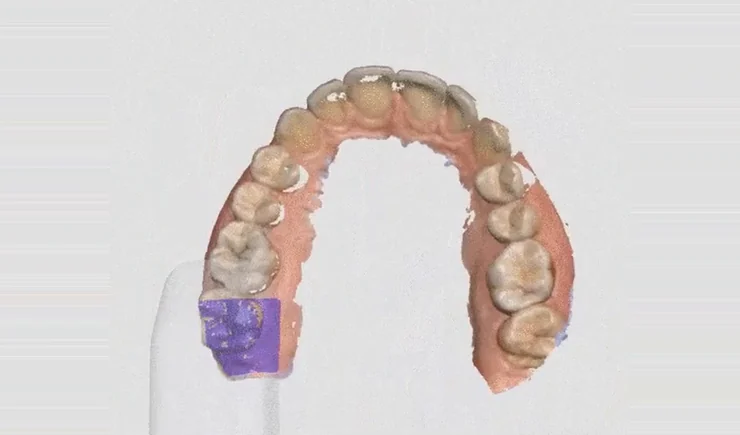
A 3D scan of your teeth, the kind in the photograph above, is a different thing. It records the surface of the teeth and gums with a handheld scanner, and it is used for aligners, veneers and implant planning. It does not show what is under the surface.
How often do you need one?
Not every visit. The ADA says your dentist will review your history and examine your mouth to decide whether you need X-rays, and that how often depends on four things:
- your present oral health;
- your age;
- your risk for disease;
- any signs and symptoms of oral disease.
Children and teenagers may need them more often than adults, because their teeth and jaws are still developing. A new patient may be advised to have X-rays so there is a baseline to compare against later. The ADA also notes you may not need an X-ray at every dental visit, and that, according to its 2024 expert recommendations, X-rays should be taken only when your dentist believes they will provide the diagnostic information needed to help you reach your best dental health.
Is it safe?
The ADA says dental X-rays emit very low doses of radiation, so the risk of harmful effects is very small. The tools and techniques are designed to limit exposure, and doses are much lower now than in the past because of advances in technology. It still recommends X-rays in moderation.
The ADA also says that leaded aprons and thyroid collars are no longer needed for patients of all ages and health statuses, pregnancy included, because they can block the main beam and lead to repeat images. Some practices still use them because of local regulations. If you are pregnant, or think you might be, say so before any X-ray; it is a routine thing for the dental team to hear. If you have questions, ask your dentist.
Bringing your earlier images
If you are a new patient, the ADA says your new dentist may ask for copies of images a previous dentist has, instead of taking new ones, and suggests asking both dentists to help forward them.
This is also why photos alone are not always enough. If you are planning treatment with us from abroad, send photos of your teeth, or a recent X-ray if you have one, on WhatsApp or through the booking form; our dental tourism page explains that this is enough for the team to suggest a treatment, the likely number of visits and an estimate before you commit to travel. How to Send a Photo of Your Smile shows what a useful photo looks like.
Before your next X-ray
- Ask what the X-ray is for, and what the dentist hopes to learn from it.
- Tell your team about any earlier X-rays, and where they were taken.
- Mention pregnancy, if it applies.
- Ask when the next X-ray is likely to be needed, and why.
Want a plan for your own teeth? Book a private consultation, or write to us on WhatsApp, +961 3 757 127.
This article is general information, not a diagnosis. Treatment plans and results vary from person to person.